The 1st Hulbert Relics Exhibition
Arirang,
Discovering Korea's Treasure
130 Years Ago
Where K-culture began, with Hulbert
Arirang, set on a Western staff in 1896,
told through Hulbert's books and belongings
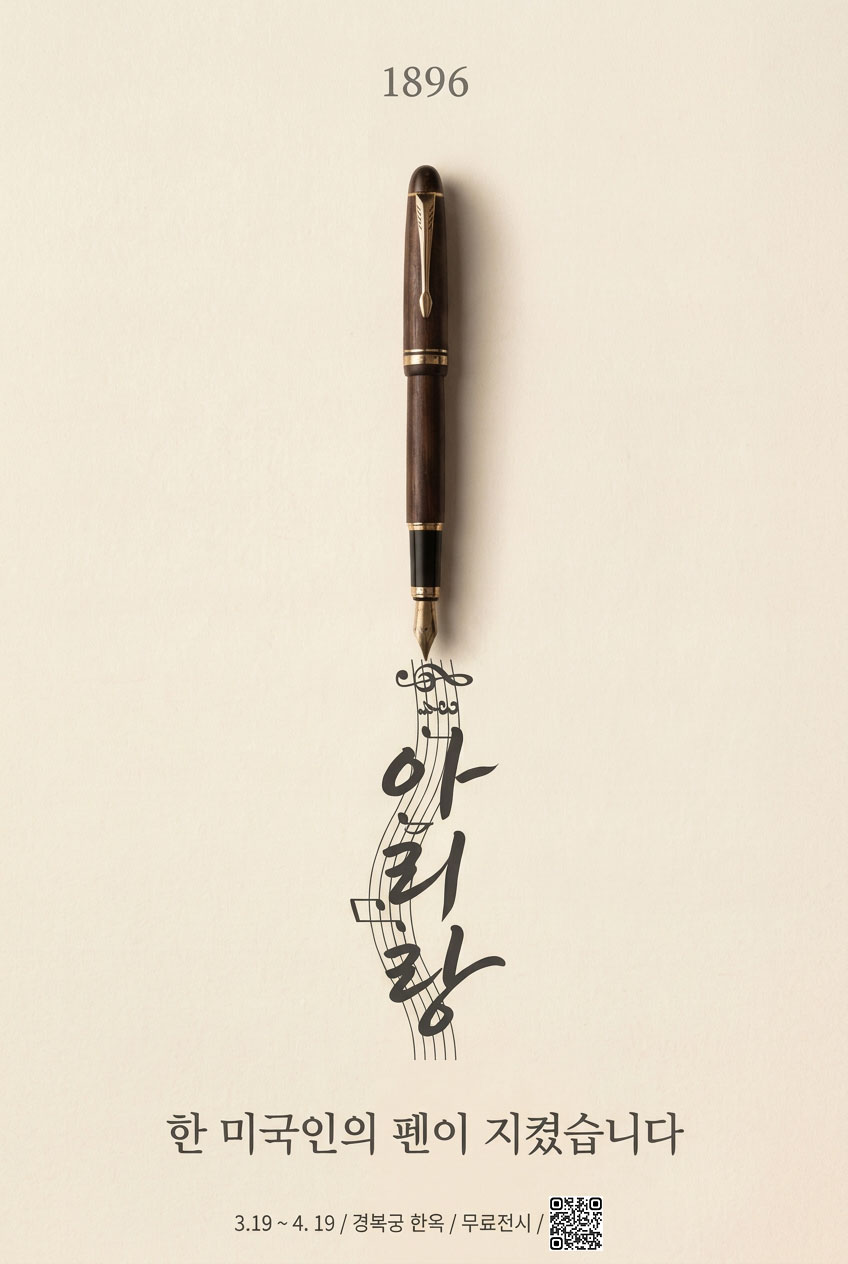
for what comes next.
Arirang
What is Arirang?
Arirang is Korea's signature folk song. No single person composed it. It was passed down by word of mouth over generations and across regions, so the melody and the words differ from place to place, as in Jeongseon Arirang, Jindo Arirang and Miryang Arirang.
In 2012 Arirang was inscribed on UNESCO's Representative List of the Intangible Cultural Heritage of Humanity. The earliest known Western staff notation of the song dates from 1896, written by an American.
First Score
The first Western score of Arirang: Hulbert's 1896 transcription
Setting Arirang on the staff
Homer B. Hulbert (1863–1949) made the earliest known transcription of Arirang in Western staff notation, in 1896. The score appeared in his essay “Korean Vocal Music”, published in the February 1896 issue of the English-language journal The Korean Repository, which introduced the song to readers abroad. It was a turning point in how Arirang reached the world, and it is now revisited as a starting point of K-culture.
A song like rice
In that essay Hulbert wrote that Arirang is to Koreans what rice is to their food: a song they could not do without.
Who was Homer Hulbert?
Hulbert was an American educator who devoted himself to the independence of the Korean Empire. He arrived in Joseon in 1886 at the age of 23, taught at Yugyeong Gongwon (the Royal English School), wrote Saminpilji, the first world geography textbook in Hangul, and made the merits of the Korean alphabet known abroad.
An Arirang timeline
- 1886 — Hulbert arrives in Joseon
- 1896 — Hulbert transcribes Arirang in Western staff notation (“Korean Vocal Music”)
- 1926 — Na Woon-gyu's film Arirang is released
- 2012 — Arirang is inscribed on UNESCO's Intangible Cultural Heritage list
- 2026 — 130th anniversary of the transcription; the 1st Hulbert Relics Exhibition is held
2026 marks the 130th anniversary of Hulbert's transcription of Arirang and the 140th anniversary of his arrival in Korea. The 1st Hulbert Relics Exhibition was the first event of the Hulbert Memorial Society's program commemorating 140 years since his arrival.
Exhibition
The 1st Hulbert Relics Exhibition — a record of the Arirang exhibition
What was on display
- Hulbert's transcribed score of Arirang and related historical materials
- The original text of the essay “Korean Vocal Music”
- Saminpilji, the first world geography textbook in Hangul
- Hulbert's personal belongings and photographs of life in Joseon
AI works
Beyond historical materials, the exhibition also showed works that reinterpret Arirang through AI-generated video and music, a new attempt to bring traditional culture and current technology together.
Programs
Programs
Book concert
“Hulbert's Dream: Joseon Shall Bloom!” — the story of Hulbert, with author Kim Dong-jin
Celebration performances
- Traditional Arirang performance (pansori and gugak)
- Folk concert (guitarist Kim Kwang-seok)
Hands-on program
- Shrink-plastic art
The 1st Dreaming Arirang AI Video Contest
Total prize money: KRW 13 million
An AI video contest on the theme of Arirang was organized alongside the exhibition, an attempt to connect Korea's traditional melody, current AI technology and the dreams of its participants. Details are available through the links below.